
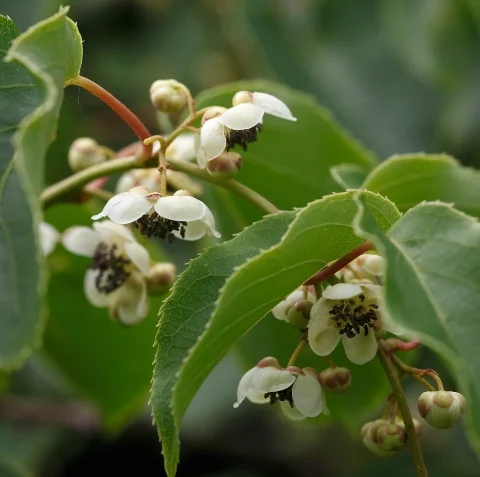
Hardy Kiwi (Male)
$119.00 Original price was: $119.00.$35.70Current price is: $35.70.
1000 in stock
SKU: 0z5kGnPsWh
Category: HEDGE PLANTS
LIGHT: Full sun, Partial sun
WATER: Keep soil moist, but not soggy.
SIZE: Quickly climbs 20 to 25 ft. tall, spreading 12 to 20 ft., with support.
| Description | Beautiful landscape specimen on its own, serves as pollenizer for fruiting, female varieties. Vigorous growing, deciduous vine. Large, creamy white flowers with extended blooming period. One male can pollinate up to 8 females including Actinidia chinensis and Actinidia kolomikta. |
|---|---|
| Bloom Time | Spring |
| Deciduous/Evergreen | Deciduous |
| Special Features | Attracts Butterflies, Pollenizer, Attracts Pollinators, Fast Growing |
| Problems/Solutions | Coastal Exposure |
| Growth Rate | Fast |
| Flower Attributes | Fragrant, Showy Flowers |
| Landscape Use | Espalier, Privacy Screen |
| Design Ideas | Kiwi vines are ideal candidates for training onto virtually any kind of arbor or trellis. Grow along the top of a fence line for a long run of foliage. Will arch over a covered gateway too. |
| Flower Color | White |
| Foliage Color | Green |
| Companion Plants | Clematis (Clematis); Cranesbill (Geranium); Catmint (Nepeta); Lavender (Lavandula); Carpet Bugle (Ajuga) |
| Care Instructions | Prefers fertile, loamy, well-drained soils. Water deeply, regularly during first growing season to establish extensive root system. Once established, water consistently; avoid soggy or overly dry soils. Fertilize in early spring and again in early summer. Prune back in late winter to control size. Provide trellis or arbor for support. |
| History | The A. arguta species was named by Friedrick Miquel, a botanist of Utrecht, Holland. It was collected first from eastern Asia where it is native to Japan, Korea and Manchuria. Due to self-fertility, this species has been grown for many centuries in China. |
| Lore | The genus was named from the Greek for ray, by John Lindley in the early 19th century, referring to the radiating styles of the flower. This is the signature genus of the Actinidiaceae family which includes many types of woody tropical vines. |